Welcome to montemumford.com
  • Home
  • Contact Monte
  • Monte's Schedule
  • Publications and articles
    • Publications and articles access
  • Video and Audio Resources
  • Monte's Blog Page
  • Video and Audio Resources

Five Tips For Expressive Conducting

26/6/2017

0 Comments

 
Is your Ensemble watching you? Why should they bother…? One of the most frustrating, challenging and rewarding aspects of conducting young ensembles is the realisation that our students actually do not need for us to be their time keepers.  So what are they looking for?
 
As conductors we often feel that our students need us to conduct strict time patterns, believing that they will become lost and disoriented without them.  Nevertheless, it is important to remember that they are, or should be the time keepers; we are, or should be the time givers. As the conductor, we are responsible for both the choosing and delivering of tempi.  It is the ensemble’s responsibility to keep the time until we wish to adjust it for interpretative reasons.  If you are finding yourself endlessly asking your ensemble to watch you, it may be that simply keeping time for them is insufficient to engage their curiosity and interest.  If they are capable of keeping time without our help then we need to offer a more creative approach to conducting which will attract, engage and hold their attention.
 
If you want to go beyond conducting time patterns and communicate a more expressive interpretation, here are five tips to consider:
  1. The very nature and shape of the three basic patterns (and other asymmetric configurations) are actually designed to convey aural and visual shapes within the context of meter.  All we need do is to work on moulding our standard patterns into shapes that look like, and reflect the style and character of the music we are performing.  The best place for finding expressive gesture inspiration is to watch proven conductors effectively employ music shapes that produce emotionally charged, exciting, significant performances.

  2. It is important that we regularly engage in active music listening, and watch a variety of live, or recorded music performances. We can then begin to experience, like children how to move, or look like the music. Do not be afraid to experiment… while in your listening/watching mode!

  3. Provide rehearsal time for your ensemble to play chorales, ensemble etudes, rhythm exercises or passages from your performance repertoire ‘un-conducted’.  It is a brilliant way to pass music-making ownership and responsibility on to your students.  It also develops ensemble listening skills like no other exercise.  In fact, it proves that they can be more in-charge of music-making then they ever believed possible.  And, it frees you from the need to ‘keep time’, allowing you to focus on the business of inspirational musical direction and leadership!  I seldom conduct the first 20 minutes of my rehearsals. This portion usually consists of Ed Lisk’s “Alternative Rehearsal Techniques of the Circle of 4ths”, scale/arpeggio exercises, rhythm vocabulary studies, ensemble etude exercises, and finally, chorales: all un-conducted!

  4. Video record your rehearsals.  This is an incredibly powerful tool, not only for considered reflection on your rehearsal technique, but also for observing on how well you effectively communicate your musical interpretations. I suppose my favourite question to myself when observing my rehearsal videos is, ”would I enjoy and be inspired by my musical body language and visual communication skills”? 

  5. Finally, reach down into your personal musicianship and take a step of faith by asking ‘what does the music itself demand of me, and how can I best communicate my beliefs to my ensemble? What is more necessary; the projecting of time or expressive phrasing, and is it possible to creatively convey both?  Even beginner ensembles can be taught to play perfectly in time without our help by simply breathing in the time and listening to each other, while we occupy ourselves with the more important issue of phrasing, shaping and inflection.
0 Comments

Listening: The Foundation of Effective Musical Leadership; A Thoughtful Continuation ... 

28/3/2017

1 Comment

 
Last April (2016) I posted an article which dealt with the importance of active and engaged listening, and its special relationship to conducting.  I have finally found the time and energy to finish the article as promised. However, much has happened to expand my thinking since I posted my original thoughts, which includes the intense mental journey I have taken in the completion of the final three Professional Development courses of the Melbourne Youth Orchestra's Professional Development Programme for Instrument Music Educators. With this in mind, I now submit the complete article for your consideration...

Often in the effort to improve our conducting skills, there comes the temptation to expend an inordinate amount of time and energy focusing on addressing the physical skills of controlling time-keeping and the development of expressive gestures, as if technical mastery of time and gestural actions should form the basis of the definitive act of conducting. (Looking like the music)
 
However, it has also been countered that the true definition of conducting is in reality a listening activity, from which the physical act of conducting derives its true inspiration. (Looking like the music, through your inner ear) In fact, informed, active, engaged listening should always be considered the major contributor in achieving successful, effective and musically satisfying proficiency as a conductor. The importance of focused, informed, and attentive listening is essential in at least two different ways:  One, the act of hearing the score and its potential interpretation, while the music still remains on the page; and two, the ability to hear the score while it is literally coming off the page. It is these two considerations, which I would like to examine in this article.
 
The first listening consideration has been addressed many times, and from many different angles. Most of us would agree that it is important that one endeavours to aim towards training themselves in effectively hearing the score, as yet unsounded on the page.  But, achieving this skill often leaves one frustrated, especially if the conductor’s piano skills are of a limited nature. A helpful analogy here is to remember that hearing a score in silence is much like using the skill of reading books silently to oneself.  How did we, as children move from reading aloud to the internalising of our reading skills?
 
The explanation is not difficult.  Obtaining effective reading and comprehension expertise in music reading requires the same mindful, or comparative repetition of basic reading comprehension skills, such as the mastery achieved through the application of vocabulary acquisition, spelling, pronunciation, and correct grammar usage.  Effective reading also requires consistent exposure to reading, including listening to someone read. It also includes aural modelling of pronunciations and the correction of definitions, and spelling errors.  It is important to understand that none of these learning activities were fast-tracked.  In fact, these activities required a careful, repetitive ‘time-on-task’ framework for achieving the mastery of silent reading over a period of time.
 
Learning to read/hear music in silence requires a systematic immersion in basic ear training and aural recognition.  These are essential skills that enable one to understand both the vertical and horizontal elements of music notation.   It is one’s technical proficiency in rhythmic notation reading, gained through internal pulse, counting and subdivision, along with the capacity to hear basic harmonic progressions, identify and sing intervallic relationships,  identify chord qualities and melody lines, combined with the ability to see phrase structures through note-grouping relationships that facilitates mastery.   These are the essential tools that will enable one to silently read/hear the score as intended.  Another important factor in obtaining effective silent score reading skills is to be found in strengthening one’s visual and aural skills through sight singing, as well as the exercise of engaging in personal music performance experiences on their principal instrument.
 
The second listening consideration is a bit more problematic, for it requires the conductor to hear, respond and adjust the music as it is literally coming off the page; all at the same time. This skill is of vital importance for achieving significant musical outcomes through effective rehearsal communication.  The process is dependent on three factors: seeing and hearing the music as it is being performed, intuitively knowing what the composer had in mind through systematic score study, and holding a personal interpretative understanding of what one desires to hear and wishes to change, thus enabling the ensemble to realise the conductor’s interpretation.  This process, of course requires that one already holds a firm belief in their interpretation of the passage, or work under consideration, knowing how they wish it to be performed, and has confidence in their rehearsal strategies, including appropriate gestures, metaphors and/or analogies. 
 
Inspirational musical leadership requires one to communicate the composer’s innate intension through understanding the emotional narrative and related connections with conviction, passion and confidence.  This includes understanding the historical, cultural, emotional and stylistic context of the music, along with its attendant set of descriptive, expressive instructions.   For instance, why is a particular passage marked ‘forte’, or why is another passage marked, ‘allargando’? To fully understand expressive directions one must also appreciate the musical context in which they appear.  The music itself is always pleading with us to listen to how it wishes to be performed, and these ‘directions’ are merely reminders of what the composer intended.   I believe that it is imperative that physical gestures and body language be derived from deeply held convictions and understanding about the ‘character’ of the music, and how the notes and rhythms should be performed in view of communicating this ‘character’. It is difficult for conductors to expect their ensembles to respond meaningfully to their gestures if the conductor does not hold a personal commitment to an authentic interpretation, character and context.
 
Therefore, this second kind of listening calls for our regular exposure to a wide range of significant music performances that feature virtuosic artistry, mastery, conviction and passion. It is vitally important to understand the correlation between regularly listening to a wide range of musical performances while appreciating their role in assisting one in forming opinions of what constitutes significant music-making in general.  This kind of listening can also provide opportunity and inspiration for the expansion of one’s emotive vocabulary of physical gestures and facial expression.  Truly effective musical communication requires empathy, understanding, emotional connection and deeply held beliefs about music performance, which can only be obtained through one’s personal exposure to great music and music-making on a regular basis.   The benefits of listening and viewing of significant music performance cannot be underestimated, for it is an essential ingredient in developing one’s inner ear towards the purpose of stimulating personal interpretation, as well as providing models of expressive definitions, which may include:  
  • tempi considerations,
  • dynamic contrasts,
  • articulations & inflections,
  • note grouping considerations,
  • phrase shape,
  • melodic/harmonic contour
  • tone colour /timbre
 
Conducting is certainly more than just knowing what is happening in the score, such as conveying a set of literal instructions; time, key signatures, tempi indications, meter, dynamic symbols, articulation markings, volume adjustment, fermata considerations, cues, etc. It is also about acquiring an informed opinion, and a conviction about the repertoire one is to rehearse/perform, while knowing how to effectively communicate their personal interpretation of the repertoire to their ensemble.  A commitment to engage on a regular basis to listening and watching of significant musical performances will go far in both feeding and inspiring our musical souls.
1 Comment

Listening: The Foundation of Effective Musical Leadership

12/4/2016

0 Comments

 
Listening: The foundation of effective musical leadership
 
Often in the pursuit of becoming a conductor, one can wind up spending a great deal of time and energy focusing on developing the physical skill of body motion and movement as the definitive act of conducting. (Looking like the music)  However, it has also been said that the true foundation of conducting in reality is, at the heart, a listening skill, in which the physical act of conducting derives its true inspiration. (Looking like the music through your inner ear)  In fact, listening forms a major key to successful and effective conducting, and can be considered essential in at least two different ways:  One, the act of hearing the score and it’s potential interpretation, while the notes still remain un-sounded on the page; and two, hearing the score while it is actually coming off the page. It is these two considerations, which I would like to examine in this article.
 
The first listening activity has been addressed many times, and from many different angles; and most would agree that it is important that we perfect this skill.  To this end, we have to train ourselves to effectively hear the score while it remains printed, yet unsounded, on the page.  However, achieving this skill often leaves one frustrated, especially if piano skills are of the limited kind.  Maybe a helpful analogy here is to remember that hearing a score in silence is much like using the skill of reading books silently to oneself.  How did we, as children move from reading aloud to the internalising our reading ability?
 
The explanation is not difficult.  Obtaining effective reading and comprehension expertise in music reading requires mindful, or comparative repetition of basic reading skills, such as the mastery achieved in spelling, pronunciation and definition comprehension.  However, it also requires consistent exposure to reading, including listening to someone read. It also includes aural modelling of pronunciations and the correction of definitions, pronunciations and spelling errors.  It is important to understand that none of these learning activities were fast-tracked.  In fact, these activities required a careful, repetitive ‘time-on-task’ framework for achieving the most effective mastery of silent reading.
 
Learning to hear a music score in silence also requires a systematic immersion in basic ear training, sight-singing and aural recognition skills.  These skills are essential in assisting both the acquisition of both the vertical and horizontal notational elements of music.  For it is proficiency in both the comprehension and the internalisation of rhythmic notation (gained through internal subdivision): the ability to identify intervallic relationships, recognising chord qualities and the structure of harmonic progression; understanding the importance of note group relationships in creating recognisable phrase structure, which enables one to actually hear the score. 
 
At this point, I cannot stress strongly enough how incredibly important it is to regularly spend quality time, both to the listening and viewing of a wide genre of music performances; live and recorded. The exposure to consistent listening and viewing cannot be underestimated as essential towards developing one’s inner ear for the purpose of acquiring a wide range of expressive definitions, such as understanding the expressive relationships of tempi, dynamics, articulations, note grouping, melodic/harmonic contour, as well as for the acquisition of physical gestures and facial expression vocabularies.  Truly effective musical communication requires empathy, understanding, emotional connection and deeply held convictions about music, which can only be obtained through exposure to great music making.  Consistent exposure to significant music performance provides the vital inspiration necessary for truly expressive leadership in music making: More about this later.
 
This kind of listening is not about the need to hear several performances of music for which one is studying, or for preparing a performance.   This is the actual need for consistent exposure to a wide range of significant music performances that will provide us with the essential framework for the developing, not only improvement in silent music reading, but will allow for a wide range of expressive and imaginative possibilities from which to draw both gestural and mental inspiration.
 
Another important way we can develop effective silent score reading skills is to be found in strengthening our visual and aural skills through sight singing and personal music performance experiences.  In my next instalment, we will explore the use of, and need for singing/playing, towards improving our score listening and interpretative abilities.   
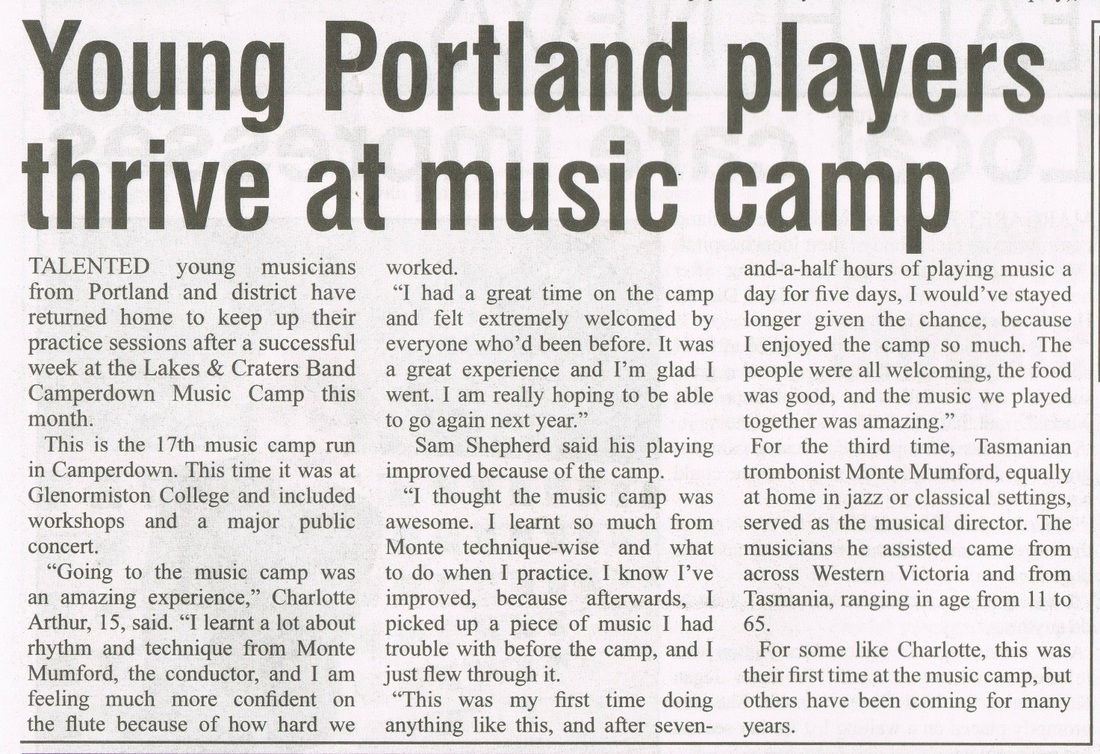
0 Comments

Brucknell Music Camp 2015 "Portland Observer" Article

17/7/2015

1 Comment

 
Picture
1 Comment

June 04th, 2015

5/6/2015

0 Comments

 
0 Comments

EFFECTIVE STUDIO TEACHING AND LEARNING STRATEGIES Pt 5

21/4/2015

2 Comments

 
In my fourth installment of Effective Studio Teaching and Learning Strategies we investigated the primary pedagogically based teaching methods with reference to human learning and relevant teaching applications. 

In my final installment I will continue the discussion on developing home study habits, along with further discussion on developing and sharing specific learning and practice skills.

A major consideration for cultivating successful individual study habits is assisting your student to understand the innate difference between ‘learning’ and ‘practice’.  In the ‘learning’ stage the student approaches the sequence of pitches, rhythms, articulation and expressive challenges at a comfortable, slow tempo allowing the student to correctly perform the whole passage in question.  In the ‘practice’ sequence the student now begins to bring the passage slowly up to required speed, while also refining the appropriate expressive control.  However, there are several elements at work in assisting students toward developing a successful individual study habits commonly referred to as ‘practice’.   

In developing effective practice habits one begins by promoting inspiration through programming the brain with superior musical images as mentioned in my previous installment discussion.  These in turn engender dreams, visions, inspired imagination and future goals. Generating excitement through reflection on these aural and visual experiences plays an important role in further stimulating the creative mind.  In effect, most physical actions that are learned are acquired through the act of imitating visual and aural images formed in the mind.  It is important then to remember that time spent in creating mental images is much more useful than mindless rote repetition on target performance material that is ultimately finite and seldom retained past the target performance or exam. 

The engagement with, and imitation of visual and aural images requires the capacity to remain ‘focused’. Concentration in the practice room can be fostered through encouraging students to be 'here and now’ in their practice sessions.  Maintaining focus and attentive listening will aid in defeating the ever-present mental and physical distractions referred to by Timothy Gallwey as ‘roof brain chatter’.  To assist in this task one should encourage students to practice in quiet environments.  One should also require that students start each practice session with a plan, or 'roadmap' in mind. ‘What do I wish to accomplish today? How will I accomplish it, and how will I recognise when my goals are achieved?’ 

“If you don’t know your destination, any road will take you there.”
George Harrison.

Another aid in improving effective practice skills is found in applying the three developmental learning stages.  These are referred to by Kohut as the Synthesis-Analysis-Synthesis approach, meaning "from the whole to the parts and back again".  The three stages are comprised of the following elements: The conceptual-learning stage where the student is presented with a model; the voluntary-action stage where the student tries to reproduce the model through trial and error practice; and the involuntary-action stage where the student’s performance through trial and error practice reproduces the original model.  I observe the model. I try to emulate the model. I evaluate my attempt to reproduce the model.  I now make the necessary adjustments and then try again, repeating the process until success in matching the model is achieved.

Like a master builder with the apprentice, first introduce the student to each tool and then show the student how to use the tool. This in turn will allow the student to create many kinds of objects of art or utility, while continuing to grow through the experience. By the age of 20, our oldest son had successfully completed building a beautiful 7 meter sailing vessel; a project of two and a half years.  His manual arts teachers had never built a boat but they showed our son how to use and care for the tools he was to employ in building his boat.   

The musicians’ inventory of tools includes the mastering of memory as the means, or process through which one is able to remember.  Developing the tool of retention is building the ability to memorise, retain or remember.  The ‘often abused’ tool of repetition is the act of doing something with thoughtful purpose and reflection, over and over, thus locking proper physical, visual and aural responses in place. As discussed above, the tool of practice is the act of repeating what is already known with a goal to perfecting the physical, visual and aural response.  The tool of experience is exercised through the actual living through of the performance act in which we are engaged.  The tool, motivation, is the desire, or the urge to achieve a goal or target found within an individual that provides the incentive for purposeful activity.  Of all the components related to learning, motivation is the most important of all. Developing and refining strategies to introduce and demonstrate these tools should be one of the foremost goals of all teachers.   

The teacher's role here is essential as student frustration and disappointment can dampen early eagerness. The use of suitable, stimulating study material and performance works, supported with proven practice strategies and identifiable outcomes is invaluable.  Systematic learning and practice strategies supplemented with excellent teaching materials and repertoire will assist in sustaining students’ engagement, ownership and achievement. Once again, the student must begin to focus on the positive first, instead of the negative; observing what has been achieved, then moving on to what needs improvement. Remember to encourage students to use their strengths in addressing their weaknesses, not the opposite. "What you think upon grows." Anon

In a sense we teachers are investment counsellors. Our students are investors.  We are asking them to invest time, money and energy into mastering their instrument.  We must be able to demonstrate that the return is worth the investment.  Our son’s vision of his completed sailboat was fed by the incremental successes he enjoyed along the way, gained through his investment of time and energy.

Finally, teaching is a profession in which teachers give lessons or instruction on how to learn. Robert Duke in his text, “Intelligent Music Teaching” puts it this way; “Teaching is that activity which causes learning”[1] After all, it is the students who do the learning.  In other words, students generally learn through the act of doing. Students who are in possession of good learning skills and enhanced musical perception generally use effective personal practice habits through attention to detail, delayed gratification and focused attention span.

The process of learning can then be defined as the act of gaining inspiration, purpose, persistence, knowledge and skill. It is important to remember that the student’s personal ownership of the process of the learning is what will ultimately produce the lasting transferral of vision, knowledge and skills.   It is essential that we imbue our students with the desire, ability and passion to go on learning well after the time for our practical input has finished.  We must always be careful to link the ongoing process of learning toward achieving the desired performance goal.  Performances, concerts, exams, festivals and auditions are no more than stops on the railway line of human experience, indicating our ongoing progress toward our ultimate musical goals.

In conclusion, for studio teaching to remain effective for both the musical and personal growth of students, it is imperative that studio teachers continue growing in their craft, thus demonstrating their relevance in today’s education environment.

References:
Gallwey, T, The Inner Game Of Tennis, Pan Books, N. Y., N.Y., USA, 1974
Kohut, D., Musical Performance, Stypes Pub. Champian, Ill., USA, 1985
Suzuki, S., Nurtured by Love, 1969. Exposition Press, Smithtown, N.Y., USA
Robert D., Intelligent Music Teaching, Austin TX, USA, 2011
Severson, P. & McDunn, M. Brass, Wind Artistry, Accura Music, N. Y, N.Y., USA, 1983

Bibliography:
Blum, D., Casals, and the Art of Interpretation, U. of Calif. Press, Berkley, CA., USA, 1980
Farkas, P., The Art Of Musicianship, Musical Publications, Bloomington, Ind., USA, 1997
Lautzenheiser, T., The Art of Successful Teaching, GIA Pub, Chicago, Ill., USA, 1992
Lautzenheiser, T., The Joy of Inspired Teaching, GIA Publications, Chicago, USA, 1994
Lisk, E., Intangibles of Musical Performance, Meredith Music, Miami, F A, USA, 1996
Lisk, E., The Musical Mind of the Creative Director, Meredith Music, Miami, FA, USA, 2010          
Kohut, D., Instrumental Music Pedagogy, Stipes Pub. L.L.C. Champaign, Ill., USA, 1996
Palmer, P., The Courage to Teach, Jossey-Bass Publishers, San Francisco, Ca., USA, 1998
Ristad, E., A Soprano on Her Head, Real People Press, Moab, UT, USA, 1981       
Stewart, D., Arnold, and J.: Legacy of a Master, Instrumentalist, Chicago, ILL. USA, 1987
Wilson, F., Tone Deaf & All Thumbs?, First Vintage Books, N.Y, USA, 1987


2 Comments

EFFECTIVE STUDIO TEACHING AND LEARNING STRATEGIES Part 4

6/4/2015

2 Comments

 
Installment 4

In my last installment I examined the issues of developing and establishing an effective home practice routine. I also discussed the importance of both accountability and ownership in addressing effective student learning development.

In this 4th installment of Effective Studio Teaching and Learning Strategies I would like to investigate the primary pedagogically based teaching methods with reference to human learning and relevant teaching applications.

Before we can know what it is that we wish to teach, how to introduce and reinforce it, we also need to know some basic tenets on how people learn.  And, we need to understand the central role of personal ownership in the learning process.  In fact, fostering personal ownership in our students generally leads to their increased motivation towards learning. Duke Ellington says; “When a man finds out what he wants to know, that’s the beginning of education”.  However, on the other hand, Plato states that, “All learning under compulsion has no hold on the mind”.  It then should become our first priority to assist our students in finding out what it is they wish to know.

The primary responsibility for studio teachers is to both passionately share and demonstrate the benefits and joys to be gained through investment in consistent, systematic personal practice. Therefore we should strive to lead our students towards developing their own learning process. The student’s growing self-motivation should, in turn be affirmed and strengthened through recognition of the rewards gained through successfully achieving realistic performance challenges. Private lessons will hold little value if students are not encouraged to engage in self-motivated personal practice on their own intuitive.      

At this point it is important to assess how we ourselves as musicians were taught, incorporating those successful elements, while discarding those that are not effective in today’s educational environment. It is important to realise that we generally teach the way we were taught – How often have we found ourselves repeating strategies our teachers used with us?

Daniel Kohut, in his text, “Musical Performance”, states that… “There are many ways of learning, and no two people learn exactly the same.  However, there are certain basic concepts of learning that can be broadly applied to almost everyone.”    This model is known as the ‘Natural Learning Process’. It is this method that children regularly employ to acquire the basic human functions. This learning model is reinforced by Suzuki’s recommendation that children should learn to perform music the same way they learn to acquire other common functions such as crawling, walking, talking, etc.

The ‘Natural Learning Process’ involves the use of four primary methods of learning:
·      Mental imagery
·      Imitation (purposeful, comparative repetition)
·      Trial & error practice
·      Body feedback

We as teachers should seek to spend more time observing how children learn and this ought be a primary requisite in learning how to teach. Children learn by watching and listening, and then trying to imitate what they see and hear.
·      Children are good at imitating others.
·      Children learn by doing, and enjoy comparative, repetitive activities.
·      Children improve their skills by trial and error.
·      Children need love, praise, encouragement and understanding as much as food and shelter to survive  and grow.

Through analysing and synthesising the above points one can then formulate an effective model for studio teaching.  The teacher presents a model of what is to be recreated, either from personal demonstration or from another source; professional recordings or live performances.  The student then tries to emulate, re-produce the model through ‘trial and error practice.  Following their attempt to reproduce the model, the student is encouraged to compare their performance against the model. Once the necessary adjustments are applied they repeat the process until a close approximation of the model is achieved.  Correct student performance is instilled as an automised habit by additional repetition through personalised application. We should strongly encourage them never to play the passage under consideration any faster than they can play the most difficult portion correctly.

This then is how we apply the ‘Natural Learning Process’ with our students.  We begin by programming the brain with suitable musical images through demonstration, exposure to fine recordings and live performance models. (Be sure to play for, and with your students.)   The student is introduced to the concept of learning to focus on the performance goal, not the performance procedure.  That is, involving students in visualising what it is they wish to sound like, focusing on imitating the model instead of trying to work out how to achieve the desired result. 

The next task is to reinforce the use of trial and error practice, always focusing on the end result with patience.  This can be illustrated by assisting the student in measuring their performance against the model they are attempting to imitate.  This is much like using a set of scales that measure and compare weights of objects against that which is be evaluated. If we are truly interested in the value of intrinsic, self-motivated study that can be applied to all learning tasks, then this system will promote personal ownership of the learning process.

At this point it is best to avoid over-verbalisation, moving directly to the creative experience of making-music itself. Be sure to avoid the temptation for excessive intellectualisation, for it is always better to show than to tell, and a picture, aural or visual, is better than a thousand words. In fact, words often have vague or multiple meanings. If a verbal instruction doesn’t produce positive results, either the verbal communication is faulty or there has been a misunderstanding of the words. Words too may block students’ ability to perform musically, often creating confusion. Timothy Galwey[3] recounts the moment he realised that his best efforts to help a tennis student failed through giving too many instructions. The student only achieved the desired performance goal when Galway physically demonstrated the action, and then asked the student to copy his example.   

Words describe experiences, but words are not the same as the experience itself.  Music deals with emotions, feelings and insights that words often cannot describe. Essentially, we learn through doing an activity much more effectively than by trying to respond to verbal instructions about the activity.  Regardless of what students may understand or misunderstand of verbal or written communications, the strategy should always lead to an artistic response.  What does the student’s musical response sound like? The use of metaphors, analogies and stories can effectively aid students in forming visual musical images.

It is vital that we direct students toward obtaining personal problem solving skills. Teachers must be able to affirm, as well as lead students in recognising when a musical target is reproduced, passes the test of aesthetic judgement and that music is produced.  As musical mentors, teachers should make it a point to share how and when significant musical performance is achieved in the lesson, as simply playing the right notes at the right time does not constitute a significant performance. The acquisition of effective personal assessment is dependent on understanding and implementing four fundamentals: good mental conceptualisation, relaxed concentration (the ability to focus completely on a specific goal), awareness of body feedback, and attention to proper posture/embouchure/hand position.

Of these four points, the ability to use relaxed concentration or ‘single-mindedness’, is the most important. Kohut describes four keys in achieving ‘relaxed’ concentration. They include: focused attention, requiring self-discipline; interested attention, requiring motivation; absorbed attention, requiring strong distraction to change focus, and merging with the experience.[4] This is where the performer and the instrument become 'one', and are now capable of playing in ‘automatic response’ mode.

In the pursuit of acquiring musical conception, Arnold Jacobs states, "Begin by training the performer's brain, not the muscles"[5]. Before a musician plays or sings even a single note they must possess a mental image of the note itself, including all of the expressive and acoustical properties with which it is associated.  Significant ‘music-making’ starts when we begin with an aural musical image. Aural images are acquired through active listening to professional performance examples. This involves a process most of us used as children when we first gained language skills: verbal association of speaking first, then reading and writing later.  It requires repetitive and attentive ‘listening and response’. Likewise, it is through the ‘listen/response’ activity that we acquire our basic musical concepts of tone, intonation, internal pulse and expression.

Therefore the quality of our musical understanding is directly influenced by the quality and variety of the music our students hear. It is essential that our students’ musical ears be ‘programmed’, through systematic exposure to the finest examples of musical performance.  The more brilliant performances our students hear, the more discerning their ears will become.

“The musical mind is concerned predominantly with the mechanism of tonal memory.  Before it has absorbed a considerable variety of tonal experiences, the musical mind cannot begin to function in a creative way complex enough to be considered art.”[6] Daniel Kohut

Effective teachers expose their students to superior musical performances while outlining specific things for which students are to listen. It is important to remember that the quality of past 'life experiences' can also influence the quality and nature of our student’s musical perceptions. These ‘life experiences’ may include reading an engaging novel, lingering over a lovely sunset, a visit to an art gallery, a great dining experience, going on an adventure or experiencing the joy of friendship, or of deep sadness and hardship.

Yet, it is one thing to work on developing our students’ musical perception. It is quite another to motivate the student in the use of their newfound musical understanding and appreciation. The student’s continued investment in personal practice requires a positive return from the time that they invest in practicing. What returns will the student receive for their investment?  I believe that our students will return again and again to the practice room when there is recognition of tangible, intrinsic achievement rewarding students with a sense of personal accomplishment and lasting satisfaction.

In my final installment (5) I will continue the discussion on developing home study habits, along with further discussion on specific learning and practice skills.

2 Comments

EFFECTIVE STUDIO TEACHING AND LEARNING STRATEGIES

22/3/2015

0 Comments

 
Instalment 3

In my last instalment on studio teaching we examined the anatomy of a typical studio lesson, starting with the first session looking at both beginners and those who have had former experience. 

In this third instalment I would like to discuss the issues towards developing and establishing an effective home practice routine. I would also like to examine the importance of both accountability and ownership in addressing effective student learning development.

It is essential that the studio teacher introduces and reinforces the importance for developing a regular practice routine.

Essentially this routine should contain the following five components:
  • Warm up
  • Technical exercises A
  • Technical exercises B
  • Solo repertoire
  • Ensemble repertoire
Before the student starts to practice there needs to be an identification process in which the student learns to determine, and set, specific goals to be addressed in the practice section before them.  What is it they wish to achieve and how will they achieve and recognise their goals?

A typical practice session should contain the following components.

  1. An instrumental/vocal warm-up routine should consist of:
  • Breathing exercises, where applicable
  • Long tone studies, incorporating the use of crescendo/diminuendo, (lip slurs over different intervals for brass)
  • Flexibility/agility exercises 

2. A Technical focus ‘A’ should consist of : 
  • Scales/modes/arpeggios
  • Rhythmic vocabulary acquisition
  • Articulation studies

3. A Technical focus ‘B’ should consist of:
  • Melodic/vocalise etudes, which focus on mastering phrasing, inflection, dynamic contrast and harmonic function
  • Expressive studies in various key centres incorporating a variety of meters

4. A solo repertoire component consisting of works from a wide variety of graded, standard works across a range of style and genre suitably chosen to match the level of the student's technical development and expressive performance ability. Don't overstep this!

5. And finally, the ensemble repertoire consisting of works drawn from the student’s involvement and commitment to large and/or small ensembles of the particular groups in which they are members.

It is also important to recognise that not all of these components need to be incorporated into an everyday practice, with the exception of the warm up segment. They can be interchanged.  For example, the student may choose to practice either  'A' or the 'B' Technical portions, or any other smaller combinations, thus relieving the student of using the same routine every day.  

We are now ready to share the process of ‘charting the course’. Having initially observed and noted the new student’s strengths and weaknesses, we must now identify and build on the student’s strengths, with an aim to addressing their present weaknesses.  Proven learning strategies are required to deliver positive, measurable results such as slow practice, the use of counting and sub-division, while employing comparative listening and repetition.  But there is also the need to identify strategies and applications for each individual student’s needs. It is important at this point to understand that every private lesson should model how students practice at home.  

What are we aiming to achieve in the student’s lessons?  How can we maintain a passion for detail without discouraging the student?  This is the great balancing act all teachers face.  When are we to speak, and when are we to listen?  Think:
  • Don't give too many instructions
  • What happens when I provide too much information?
  • Aim to be a good listener?
  • What is criticism, and how and when should it be used?
  • What is praise, and how and when should it be used?
  • What is genuine encouragement?

Remember: it is easier to teach the way we were taught than it is to teach the way we were taught to teach or should teach. For personal and professional growth, consider regularly recording lessons, either using video or aural. Recorded lessons and practice sessions can provide the best feedback on the above points. 

Further considerations for setting assignments:
  • In setting assignments consider that less is more, and programme for success while maintaining the scope and sequence of the method book exercises 
  • Remember the importance of choosing repertoire that is suited to the general perforamance abilities
  • Remember to set time aside for reflection and encourage reflection in the lesson
  • Include practical modelling on ‘how to practice’
  • Be sure to foster and include opportunities for self assessment
  • Be transparent, consistent and clear in establishing assessment criterion
  • Be consistent from week to week in assignments and expectations
  • Remember to organise assignments so as to lead toward continued development
  • Regularly consider the quality of feedback to the student
  • Assist the student in time management
Setting a weekly written assignment and noting the student’s progress from week to week assists in defining and recording the direction of student’s successful growth, assisting in developing commitment and accountability.

"Teachers are the mediators who provide, or fail to provide, the essential experiences that permit students to release their awesome potential..." J.S. Acaro

"A wise teacher makes learning a joy" Proverb 

In my next instalment I would like to explore some primary methods of pedagogy in human learning, with applications for assisting studio teachers with their task of assisting students in reaching their full potential.

0 Comments

EFFECTIVE STUDIO TEACHING AND LEARNING STRATEGIES Pt 2

13/3/2015

0 Comments

 
Installment No. 2

In my last installment I introduced the need for a fresh look at the importance and centrality of the private, or school studio music teacher in in the music student’s life as a developing musician.  I also examined the various skills and experience necessary for preparing the studio teacher to engage and empower their students towards developing successful and fulfilling learning skills. 

In this installment I want to examine some of the essential elements that a ‘first lesson/session should contain.

A 'first session' should begin with introductions, which are then followed on with the collection of background information on the new student.  The easiest way obtain this valuable information is through an interview process, where one asks the student to briefly relate their past musical history, school music experience, and personal work ethic. If the student is not a beginner you should also ask about their current practice routine. The interview is generally followed up with providing the student with a standard form that allows for easy collection and organisation of routine information, including name, musical experience, former school, previous teacher (if appropriate), and contact details if not via the school.

 The next item of business should be to share your expectations, including length of lesson time, policy on missed lessons and explaining financial arrangements, if any.  Sometimes it is easier to convey this information in a personal fact sheet, which should include your strategy for a practice routine, the amount of daily/weekly practice you expect, and a discussion on the three types of goals present in successful learning.

Goal identification
1.  Identification of the long-term goal, the ‘vision’ or ‘dream’ to which they aspire. 1 to 10 years. Why has the student chosen their instrument, and what do they wish to accomplish?  You may wish to explain that these goals will most likely continue to change and expand as they develop, both physically and mentally.

2.  Mid-range goals; those that are of a more specific nature and are measurable and achievable within 1 to 3    months. For example,
*  The achievement of a specific piece of repertoire, either solo or ensemble works
*  The mastery of a concert performance programme of either solo or ensemble works
*  Mastery of a range of specific technique or interpretative challenges
*  Advancement on a specific skill acquisition; rhythmic, melodic expression, or range challenge 
*  Improved technique and or dynamic control.

3.  Short-term goals, which include very specific tasks or targets that are measurable and achievable within 5    to 30 minutes, or up to one week. (length between lessons) These short term goals should include the correct rendition of: 
*  full value notes, 
*  measured by sub-division, 
*  a specific rhythmic challenge, 
*  a specific fingering passage, 
*  a specific articulation challenge, i.e. staccato, legato, slur, etc., a specific phrasing/expressive challenge, etc.  

All three types of goals should be considered working concurrently. It is essential that the teacher begins to encourage the transfer of these goals to their student’s way of thinking and their individual approach to daily practicing.

If the student is a beginner, it is now time to introduce the instrument itself. Assuming you are confident that the student’s chosen instrument is a reasonably physical fit (hand size, arm length, height, lip shape and teeth (for wind instruments), you will now need to clearly describe and demonstrate the following points systematically, regularly checking to see if the student understands:
* The parts of the instrument and how the instrument functions
* How to care for the instrument
* How to assemble the instrument (if applicable) 
* Appropriate posture and hand position 
* The formation of the embouchure (if applicable)
* The principles of tone production and projection, and if applicable, air support

Before the close of the 1st lesson it is imperative that the student shows a basic intellectual understanding, and can physically demonstrate the correct responses to the above points.  

If the student is not a beginner it is now time to hear them perform a sample of music from a recent performance experience, or some examples on which they have been recently working.  It is best to have a set of criterion, which will enable you to look and listen for basic skills and performance fundamentals. This should provide an indication of the student’s current state of development and future direction. 

The criterion should include the following considerations:

1. Posture, hand & finger, bow or stick/mallet positions, and embouchure, voice placement (where appropriate)

2. Tone quality formation (breathing and/or manual control of bow or mallets)

3.  Attention to technical detail such as:
·      consistent tempi
·      ‘full value’ notes
·      attention to articulations
·      instrument/voice range
·      vertical rhythmic precision and sub-division
·      technical facility/agility
·      familiarisation with musical terms
·      key and time signature cognition                    

4.  Aural awareness and personal perception
·      tone quality & pitching skills
·      intonation
·      aural and visual evaluation skills

5.  Musicality
·      expression (dynamics, nuance, agility and inflection)
·      phrasing and harmonic contour: cadence arrival and departure

6.  General deportment/attitude/expected work ethic

After the student has performed, a brief discussion should follow covering the teacher’s perceptions of the student’s present performance ability, remembering to be encouraging, supportive, and honest.      

For both the initial beginning and the continuing student, it is now time for making the 1st assignment.  The studio teacher will have a range of warm-up routines, a collection of tutor books, which include technical studies scales, arpeggios rhythmic vocabulary and melodic etudes on which they can use and/or recommend. They will also have a variety of appropriate solo repertoire, in which they have developed sufficient confidence in their suitability.  If the private lesson is within a school environment, there may also be curriculum materials to be incorporated.  As your first lesson is of utmost importance, the assignment should be drawn from the student’s present developmental stage and musical understanding.  It should also reflect a new direction. Remember to keep this first assignment simple, attainable and especially programmed for success. 

In my next installment I would like to discuss the issues of teaching material and warm-up training strategies and these are how these are connected to establishing good attitudes and motivation towards establishing effective home practice routine. I would also like to examine the importance of accountability and ownership in addressing student learning development. 
0 Comments

EFFECTIVE STUDIO TEACHING AND LEARNING STRATEGIES Pt 1

5/3/2015

1 Comment

 
The success of our music student’s capacity to acquire effective learning and performance skills is often directly linked to the effectiveness of private music studio teaching, in or out of the school environment.   Learning skills gained and fostered in the studio should in turn increase the student’s ability to succeed and excel in the experience of music making, and learning in general.      

Who then are the people that are generally placed in charge of the individual musical and personal development of our vocal and instrumental music students? On what criterion are they hired and what training have they received in the art of studio teaching pedagogy?  In fact, what training have they received towards preparing them for one of the most demanding, challenging, thankless and yet rewarding jobs in our music departments?  What professional development training is available for further development, and how many teachers can, or are willing to avail themselves of professional development opportunities?  Is there sufficient communication between itinerate and permanent staff members in our department?  And finally, how are these integrally important staff members included in the overall planning and course development for the future directions of our music departments?

These are complex questions, which I suspect get lost in the day-to-day teaching and administration load.  After all, who needs another administrative task?

It is my hope that these instalments on the art of studio teaching will provide opportunities to explore the essential, complex and often little understood role of the private studio teacher.  I trust that I will be able to offer some fresh ideas and strategies for all who are involved with either private teaching or the supervision of studio teaching in their institutions.

Early on in my 20 year tenure as Senior Lecturer in Music at the University of Tasmania, I became convinced of the urgent need to address the lack of training for studio/private music teachers, for it is common knowledge that most music graduates at some point will find themselves in a private teaching role: There seemed to be no provision for the neglect of this obvious fact. Therefore, one of my self-appointed responsibilities was to convince my colleagues of the crucial need to include a yearlong unit on studio teaching within the general undergraduate course.  My first task in writing the unit was to consider the many facets of this complex job. I decided that the best place to start was with a comprehensive position description, beginning with a basic list of essential elements required for successful studio teaching, such as:  The personal and professional qualities and abilities studio teachers were likely to need, and what economic and business knowledge/skills the job would require. Also included were the knowledge base and communication skills the studio teacher would need to effectively accomplish their task.  Focusing directly on the above considerations, I believe the studio teacher will need to:

*  Acquire and develop the ability to both listen and observe discriminately, through employing a set of visual and aural 'templates' (more on these later)

*  Introduce and model correct responses while encouraging the student’s engagement with, and use of critical listening and observation

* Successfully diagnose performance strengths, while identifying specific areas for improvement  

*  Introduce, demonstrate and reinforce effective practice/learning strategies

*  Shape, guide and encourage, while holding the student accountable

*  Inspire students in the pursuit of excellence, tempered with patience and compassion

*  Encourage students’ personal ownership in developing their own personal learning processes.

*  Possess a good understanding of best business/tax practice.  

It is often our personal experience, past, present and future that usually inspires and informs us towards developing and delivering a truly effective teaching style.  Of course, this requires constant attention to our own personal growth and development, which includes a commitment to continual personal study, listening, searching for new and proven teaching strategies, impatience with the mundane and intolerance of the mediocre. 

Studio teachers who aspire to excellence in their craft will need to maintain their love of, and passion for music and music-making, as well as genuinely desiring to share their passion and musicianship with others. The rewards for diligently seeking to develop teaching skills, or aiding those who are seeking to improve their craft can be equally exciting, such as discovering more questions than answers, experiencing frustration, joy, anger, success, failure, triumph, fatigue, elation, challenge and disappointment.  One of the major difficulties of this job lies in the close, ‘one to one’ relationship between teacher and student. In a sense, there is nowhere to hide. Our strengths and weaknesses are laid bare for students and colleagues to see, through either the success or failure of our students to advance in their musical development.  Is it any wonder that students will travel across oceans and continents to study with a celebrated teacher?  The reputation of an inspirational teacher often functions like a beacon; they draw all who seek success from contact, study, and the inspiration of a master.  Many teachers continue to make significant impact on lives of their students and colleagues throughout their life.  

Having established the fact that studio teaching consists of a number of complex demands and abilities, it is important teachers continue to seek out strategies that will assist in meeting those demands and acquiring those abilities. The newly gained strategies will, in turn enable one to provide students with the very best learning environment and learning skills, allowing for successful development of the student’s musical potential. Therefore, fostering a commitment to professional development is essential.  It is easy to forget that one needs to frequently re-calibrate their personal approach to teaching and learning.   New strategies appear regularly and we need to avail ourselves of them. Conferences are great places to mix with inspirational, leading educators where shared philosophies and successful strategies can be heard.  One will also find that their network of colleagues will have many similar issues and may have the answer for one’s specific need.  Then again, there are great resources in new and old texts, as well as great ‘on-line’ resources literally at our fingertips.

One of the most important traits of a successful studio teacher is that of personal and professional integrity, which leads me to one of my favourite quotes’.

“My mission is to live with integrity and to make a difference in the lives of others” Jeff Morrow


Studio teachers can also bear a great responsibility for their student’s personal well-being, self image and confidence. One must remain honest, discreet, trustworthy, compassionate and wise in all their dealings with their students.  If we fail in this responsibility we may have doomed our students to a musical life of mediocrity, or worse.

In my second instalment on studio teaching we will examine the anatomy of a typical studio lesson, starting with the first session.  

1 Comment
<<Previous
Forward>>

    Author

    Mr. Mumford holds an international reputation as a conductor, adjudicator and clinician, contributing regularly to the field of music education and performance studies through conference presentations, publications, professional development offerings, and master classes. He is highly regarded for his musical experience, expertise, passion and effective teaching style. He is in demand as a guest conductor, music education consultant, and adjudicator, providing performance strategies and professional development for music educators, administrators and students alike. From 2015 -2017 Mr. Mumford was engaged as Advisor and Lead Educator for the Melbourne Youth Orchestra Teacher Professional Development Programme. ​  

    Archives

    April 2025
    February 2025
    June 2021
    February 2021
    May 2020
    November 2019
    October 2019
    September 2019
    August 2019
    July 2019
    June 2019
    May 2019
    November 2018
    October 2018
    September 2018
    March 2018
    July 2017
    June 2017
    March 2017
    April 2016
    July 2015
    June 2015
    April 2015
    March 2015
    December 2014
    November 2014
    October 2014
    April 2014
    March 2014
    February 2014
    January 2014
    December 2013
    November 2013
    October 2013

    Categories

    All

    RSS Feed